Showing posts with label baking bread. Show all posts

Thursday, 9 December 2021

"Oh, Look! We Have Unexpected Company!" Quick Bread


My husband was really bad about inviting people to dinner and then forgetting to tell me about it until our guests pulled into the driveway. Seriously. Thirty four years of marriage never broke him of the habit. After so many years of magically conjuring dinner for four, or six, or eight out of ingredients planned for just the two of us, I'm really good at it. 

One of the things I learned very quickly about stretching meals is that carbs are your friends. Having a few good quick breads in your repertoire can be a great help when unexpected company arrives at dinnertime.  

Served before dinner, hot from the oven, with butter or with olive oil and balsamic vinegar, a quick bread can buy you some extra time to prepare the rest of the meal. It can help take the edge off appetites too, which means main course protein servings can be smaller and the meal can be more heavily weighted towards vegetables that are quick to prepare. 

Your guests don't have to know any of that. You can keep mum and let them be impressed with what a special treat they're enjoying. They'll love it.

You don't have to re-invent the wheel either. Learn to make a basic quick bread like this beer bread. Beer bread's been around forever because it's easy to make and it tastes really good. 

Almost all beer breads call for self rising flour: a pre-mixed blend that also includes baking powder and salt. It's not an ingredient commonly called for in recipes from this region so I don't go through it quickly enough to use up a bag before it's past its "best by" date. When I bake a recipe that calls for self rising flour I make this substitution:

For every cup of self rising flour called for in a recipe, I use 1 cup of all purpose flour, 1-1/2 teaspoons of baking soda, and 1/2 teaspoon of salt. 

I've already done the math for you in this recipe, then adjusted so it's less salty and there's no aftertaste from the baking powder.

You're welcome. 😊

To make this bread, you'll need:

  • 2-1/2 cups all purpose flour
  • 1 Tablespoon baking powder
  • 3/4 teaspoon salt
  • 1 Tablespoon sugar
  • 1/2 teaspoon each of onion powder, granulated garlic, ground dry rosemary, oregano, and basil
  • 1 12-ounce bottle of beer (I use a lager)
  • 1/4 cup olive oil

Put all the dry ingredients in a bowl and use a whisk or a fork to stir them together. (A whisk or fork won't compact the flour. A spoon would.)

Add the beer and then the olive oil. Stir until combined but don't over-mix the batter. Lumpy is okay.

Spoon the batter into a buttered or oiled  9 x 5-inch loaf pan. It'll take about 45 minutes to bake at 375F. 

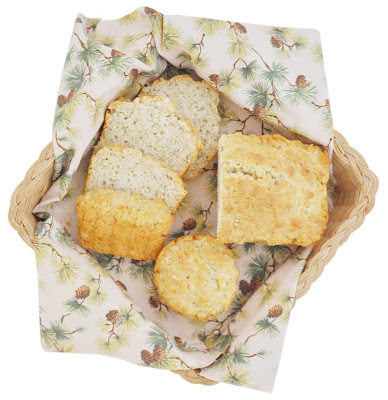
If you portion the batter into smaller containers you can shorten the baking time. Half pint/125 ml Mason jars work perfectly. The smaller loaves cook in about half the time it takes to bake a 9 x 5-inch loaf, and they're easy to present in a bread basket; no slicing required. 

Beer bread is always best served hot from the oven. If you have leftovers and want to reheat them, you can slice them and toast the slices or you can wrap the leftovers in foil and reheat them in a 350F oven for 15 to 20 minutes.

Now, go forth and fear unexpected company no more. You've got this!


Wednesday, 8 December 2021

Rosemary Raisin Bread


In 1977, I bought the Sunset Cook Book of Breads.  It was one of the first cookbooks I ever purchased - a paperback - and I have it still, so well loved that it's mostly held together with sticky tape. This recipe comes from that book but I've adapted it to suit my tastes and baking style over the years. It's a surprising combination but the flavours work together really well.

I enjoy this bread toasted, with crabapple jelly, or as a sandwich bread, with ham, a mild cheese, and some sweet mustard. 

I should mention that I eat every dish I make for my blog. Nothing goes to waste. The wedge of bread I cut out of the loaf for the photo was made into a bread pudding, with pears.  😊

To make Rosemary Raisin Bread you'll need: 
  • 1 to 1-1/2 cups of raisins (I only had 3/4 cup of raisins when I baked the loaf you see in the photo. It was not enough.)
  • 3/4 cup raisin soaking water
  • 2 Tablespoons honey
  • 2-1/4 teaspoons active dry yeast
  • 2 eggs at room temperature
  • 1/4 cup neutrally flavoured cooking oil (I used sunflower oil)
  • 3 to 3-1/2 cups bread flour (sometimes called hard flour)
  • 1 Tablespoon fresh rosemary, chopped very fine
  • 1 teaspoon salt 
  • 1 Tablespoon cold water
Put the raisins in a heat proof bowl or measuring cup and pour boiling water over them.  Let them soak until the water has cooled to 110F.

Drain the water off the raisins, reserving it and setting the raisins aside. Pour 3/4 cup of the raisin soaking water into your mixing bowl. Add the honey, stirring to dissolve it into the water.  

If the honey won't dissolve completely, put the water/honey mixture in the microwave for a few seconds and then stir it again. If you put the water and honey in the microwave, remember to allow it to cool down again, to just above body temperature.

Sprinkle the yeast over the water and honey mixture.  Let it sit for about 10 minutes, until the yeast has dissolved and started to foam a bit. 

Crack 1 egg plus the white of the second egg into a small bowl and beat them with a fork. (Reserve the yolk from the second egg for later.) Pour the beaten egg into the water/yeast mixture, then add the oil, and the drained raisins.

Add in 3 cups of flour, the rosemary, and the salt in the order given here. (Salt impedes the rising action of  yeast. Putting it in last helps insulate the yeast from the salt.)

If you have a stand mixer, use a dough hook to mix the bread, adding more flour if the dough is sticky.  You'll need to mix it for at least 10 minutes, until the dough becomes elastic and pulls away from the sides of the bowl.

If you're kneading the dough by hand, spread the remaining half cup of flour on your board and knead the bread until it's elastic. This can take up to 20 minutes.

Wash out the mixing bowl and coat the inside of it with some olive oil. Put the dough in the bowl and turn it until it's coated all over with the oil.

Cover the bread dough with waxed paper and let it rise until doubled in size, about 1 to 1-1/2 hours.

Punch the dough down and knead it a few times to release the air.  Shape it into a sphere and place it on a parchment lined baking sheet.  

Let the dough rise until puffy; about 30 to 45 minutes.

Beat the reserved egg yolk together with 1 Tablespoon of cold water, then brush it over the loaf.

Use a floured, knife with a narrow blade to cut an X in the top of the loaf.

Bake the bread at 375F for about 30 minutes, turning it at the halfway point of the baking time. 

Start checking it for done-ness at 25 minutes. You'll know it's done when you tap on the top crust and it sounds hollow.  If it doesn't sound hollow, return the bread to the oven and turn off the heat.  Let the loaf finish baking in the residual heat.

Cool the bread on a wire rack for at least 30 minutes before slicing it.

Monday, 6 December 2021

Olive Bread


When things get hectic, good bread is a fine thing to have on hand.  You can serve it as toast alongside a bowl of soup or some scrambled eggs, you can throw together a quick and tasty sandwich, or you can assemble the makings of a savoury bread pudding and pop it in the fridge, ready to go into the oven when you get home from work, or in the morning if you have guests for breakfast or brunch. Olive bread works well for all these things.

I usually bake this bread in a rectangular loaf pan because if I'm using it to make sandwiches that shape ensures that all the slices will be similar in size and shape.  Sometimes, though, I divide the dough into three or four portions and use it to make pizza crust, or I'll form it into a round if I want to make muffaletta or some other stuffed loaf. The baking times will, of course, vary depending upon the size and shape of the bread.

To make this bread you'll need:

  • 2 cups warm water, slightly above body temperature but not exceedin 110F
  • 2 Tablespoons sugar
  • 4-1/2 teaspoons active dry yeast
  • 1/2 cup olive oil
  • 6 -1/2 cups flour
  • 1 teaspoon salt
  • 2 Tablespoons Greek Seasoning (I use this recipe, shared on AllRecipes by Margaret Havenar)
  • 2 Tablespoons of finely diced sun-dried tomatoes 
  • 1 cup sliced green olives
  • 1 cup sliced black olives

Stir the sugar into the warm water until dissolved. Sprinkle the yeast over the water and let it rest until the yeast has dissolved and started to foam up a bit.  (This usually takes about 10 minutes in my kitchen.)

Add the olive oil and 3 cups of flour, mixing them until combined.

Add in the salt, Greek seasoning, sun-dried tomatoes, olives, and the remaining 3-1/2 cups of flour. Continuing mixing until a firm dough forms. 

If you're mixing it in your stand mixer, using a dough hook, set the mixer on low speed and continue mixing for 5 to 10 minutes, until the dough is elastic and springs back when you poke it lightly with your finger.

If you're mixing it by hand, knead it in the bowl so you don't have to add extra flour, working it for about 10 minutes until the dough is elastic and springs back when you poke it lightly with your finger.

Turn the dough out onto a lightly floured board or onto a sheet of waxed paper or parchment. Wash and dry the mixing bowl, then lightly oil the inside of the bowl.  Return the dough to the bowl, turning it so it's lightly oiled all over, then cover the dough with a sheet of waxed paper or a slightly damp cloth.

Let the dough stand until doubled in size.  (My home tends to be a bit chilly at this time of year - around 65F most days - so the dough can take up to 2 hours for the dough to rise. If your space is warmer the dough will double in size more quickly.) While the dough is rising, butter or oil two loaf pans.

When the dough has doubled in size, punch the dough down, knead it a few times, then divide it in half and form each half into a loaf.  Place the formed loaves into the prepared pans and let them rise again until doubled in size. 

When the loaves have risen brush the tops with olive oil. Bake them on the middle rack of a 375F oven for about 45 minutes, rotating them at the 25 minute point.

When the bread is done it'll be golden brown in colour.  If, when you turn a loaf out of the pan and tap on the bottom crust, it sounds hollow you'll know it's cooked through.  If it doesn't have that hollow sound put it back in the pan and return it to the oven. Turn the oven off and allow the bread to bake a bit longer in the residual heat.

Turn the baked loaves out onto wire racks to cool.  Leave them for at least 30 minutes before slicing the bread.

Seriously, you need to make this.  It's SO good!